The Earth laughs in flowers. ~Ralph Waldo Emerson~
Showing posts with label Plants. Show all posts
Tuesday, 2 September 2014
Meditations of John Muir
“This grand show is eternal. It is always sunrise somewhere; the dew is never dried all at once; a shower is forever falling; vapor is ever rising. Eternal sunrise, eternal dawn and gloaming, on sea and continents and islands, each in its turn, as the round earth rolls.” ~John Muir~
Labels:
Back-to-Nature,
Photography,
Plants,
Poetic,
Quotes,
Thinkers
Osho on Nature
Look at the trees, look at the birds, look at the clouds, look at the stars... and if you have eyes you will be able to see that the whole existence is joyful. Everything is simply happy. Trees are happy for no reason; they are not going to become prime ministers or presidents and they are not going to become rich and they will never have any bank balance. Look at the flowers — for no reason. It is simply unbelievable how happy flowers are. ~Osho~
Labels:
Back-to-Nature,
Photography,
Plants,
Poetic,
Quotes,
Thinkers
Damp Meadow Species for Borders
|
Primary damp meadow herbs
|
Secondary meadow herbs to consider
|
|
Common bentgrass
Crested dogstail
Smaller catstail
Hard fescue
Trophy chewings
fescue
Smooth stalked
meadowgrass
Ladys Bedstraw
Ragged Robin
Ox-eye Daisy
Meadow Buttercup
Meadowsweet
Ribwort Plantain
Self Heal
Common Sorrel
Yellow Rattle
|
Agrimony
Betony
Birdsfoot trefoil
Buttercup, meadow
Common centuary
Cowslip
Cranesbill, meadow
Cuckoo flower/ Lady’s smock
Dyers Greenweed
Field Scabious
Goatsbeard
Great Burnet
Knapweed, common
Pasque Flower
Quaking Grass
Rock Rose
Salsify
Snakeshead fritillary
Sneezewort
Vetch, common
Majoram
Meadow Vetchling
Meadow Saxifrage
Musk Mallow
Wild Carrot
Wild Thyme
Yarrow
|
Low Conifer Trees
The low conifer trees provide some variety in the garden. They break up the long line of sight and permit a perching spot for the chickens in rainy weather.
Margins, Hedges and Fences
Site of removal of large fig tree.
Site of previous Leylandii hedge along border of lawn. It has since been planted up with some perennial ornamentals but has become overgrown. I have ear- marked the border for damp meadow herbs in future.
Further down the border, the plants thicken into bushes and an overgrown ornamental grass specimen. This has been left for conservation cover and to maintain visual variety in the garden.
The border runs up to the vegetable plot and provides a natural screen containing brambles, roses and other bushes.
Mature Leylandii adjacent to the vegetable plot. As they are getting quite obtrusive and will probably undermine a neighbour's outbuilding, they will ultimately be removed. I intend to plant an indigenous conservation hedge in its place, incoorporating hawthorn, beech, blackthorn and alder. They could be maintained by laying every 7- 10 years. Food plants such as blackcurrents, brambles, and elder would be encouraged.
Spring daffodils in the margins.
The very back border of the garden was reinforced with materials I found whilst clearing the compost heap. It has so far remained stock proof, preventing egress of chickens and access by foxes, farm dogs or cats.
This area right at the back of the garden and pressing up against the farm stables is due to be up- planted with architectural herbs such as comfrey, mullein, or ferns. I will probably clear the area of debris and use some excess compost as a substrate into which to plant the herbs.
Nettle Stand & Log Pile
It is a basic tenet of conservation that certain areas need to be given over to nature. In the Permaculture design, wild areas supply highways into and out of more intensively managed sectors by encouraging predatory insects and birds, self seeding flowers and other ‘blow ins’ which contribute to species diversity and resilience. At the back of the garden, adjacent to the orchard is a nettle stand which had an accompanying log pile from some previous clearance work. Nettle is particularly good for butterfly conservation. It did cross my mind, however, to bring the area into production for food; it has a generous supply of sunlight, and the fact nettles are growing suggests there is a good mineral composition to the soil.
The soil, however, is full of small rubble and pebbles, and would be difficult to dig, or grow root crops. The sector is also next to a tall (7 ft) breeze block wall, which abuts on to the adjacent farm. Peeking over the wall reveals a disused stables with concrete floor, about half an acre of overgrown waste land, a rusting tractor, and a number of plastic 50 litre containers that appear to have had agricultural chemicals in at some point. Right next to the wall seems to be a storage/ loading bay which may have been used to load up tractors or booms with chemical sprays. As I cannot rule out the containers are from pesticides, and leaching has not occurred, I am disinclined to launch into cultivation of this portion of the garden, preferring to use it as a buffer against a possible contamination source. The sector is some distance from the house, and watering and intensive maintenance tasks would be problematic, applying some zonal thinking to the situation.
Wherever humans have settled, nettles appear. The oldest human latrines, tips, food stores and waste ground have nettles growing on them. They thrive on the nutrient rich waste of humans, and as a result purify the ground and redeem the soil. For now, letting the nettles do their work is satisfactory. If in future this area is to be cultivated, I would suggest shrubs and fruit bushes to accompany the orchard plants and circumvent any problems with digging soil.
The A- Frame
The A- frame was made from bamboo sticks joined
by string in the same manner as the tomato plant supports in the greenhouse,
and were made at the same time. The A- frame consisted of several of these
joined together to make a 3D structure approximately 8ft long x 6 ft high by 5
ft wide. There were longitudinal bamboo supports through the structure to
stabilise it. This made for a light, transportable structure on which plants
could be grown, and was used as an experiment to grow gourds and peas together.
More precisely, the arrangement was:
- Sweet peas, French beans up the sides of the A- frame
- Pumpkin and Butternut squash in the central portion of the structure.
Both types of plant are climbers which use
tendrils, but the peas are better at climbing and siting them on the outside of
the A- frame facilitated their fast growth. The gourds found support in the central
and lower portions of the frame.
The idea was designed to enable a 3D vertical
polyculture of companion plants which made maximum use of space for
photosynthesis, and which was capable of protecting itself from winds and water
loss. The A- frame can be moved about to different parts of the garden each
year in order to nitrify and fertilise the soil, as the peas are legumes.
My first location for the A- frame was in the
cenrtre of the orchard. As discussed in the Orchard section, I was making an
attempt to improve the soils there with view to making a backyard orchard. The
plants grew very well and led me to speculate they would be well suited to
being brought into the vegetable plots to migrate my traditional rotational
system into more of a Permaculture.
Vegetable Plot
Double digging is more of a traditional than a permaculture technique. It has obvious disadvantages; it is labour intensive, it disturbs the seed bank and can result in a rudarel explosion, it can disrupt quality of soil which may have taken years to build up, and it can contribute significantly to erosion. In this case, however, I felt it was well indicated; Apart from a best guess, I had no idea what the underlying soil quality or previous land use was like; the clay waterlogged soils could do with turning over, I was growing predominantly root crops and so would benefit from deeply tilled soil with no foreign matter (rocks, household waste and other debris), and several medium sized ant colonies were dispersed for crops. Whilst I wouldn't do this every season, as an initial move to crop cultivation it proved successful. In successive years I will be able to rotate and build soils, as the compost and green manure (clover) will be available for use. [Please note: the above images are of a different garden which I double- dug. I did not photograph the study area whilst digging].
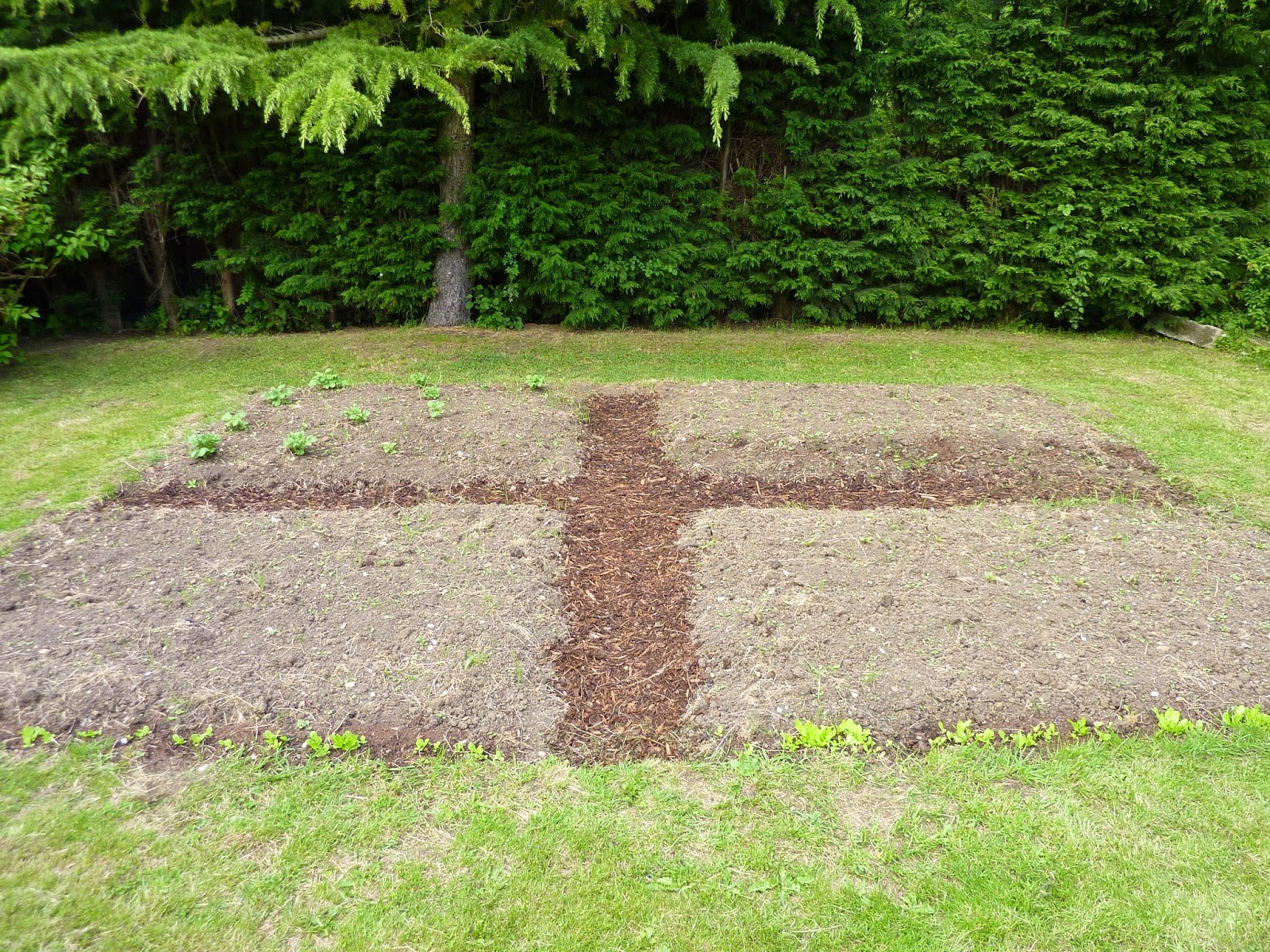
The vegetable plot is a traditional 4- plot rotation separated by a crossed path of bark chippings. The rotation is to go clockwise each year to avoid soil borne pests and diseases, and to permit the soil to recover from the unique absorptive demands of the crop being grown. The vegetable plot has a central cross of bark chippings to separate the individual rotations. It is dug deeply to ensure adequate separation. The use of bark chippings is of value because in wet weather it serves to drain water away, yet acts as a reservoir in dry weather, thus acting as a natural buffer against waterlogging or drought. It is a weed- free and convenient way to attend to crops, and prevents compaction of soil. The material is an inexpensive natural product which will biodegrade slowly without leaving any toxic or unpleasant residue.
Salad vegetables growing at the periphery of the plots. These plants can be grown intermingled with the other (root) crops and do not negatively influence the rotation.
Above: the first step towards verticality and ployculture. I have added red and black current bushes at the periphery of the plot. In subsequent years other plants are to follow: rhubarb, herb bushes such as rosemary, lavender, sage, and other backyard permaculture orchard standards such as apple, pear, apricot, plums, etc. In this way, the food growing area will migrate from a traditional 4- plot system with straight lines, to a more various and stratified polyculture.
Thursday, 28 August 2014
Greenhouse
This is a photograph of the greenhouse after clearing it of the intrusive vine, installing the wire shelving, and attaching the shallow shelves for salad vegetables to the potting table (not visible). On the L side of the greenhouse in the picture, against the sun- facing glass I affixed 3 A-frames made of bamboo and secured with twine. The A- frames were used as a surface against which I grew several varieties of tomatoes.
Above: Shallow shelves in operation, planted up with salad seeds. Cultivating salad leaves in this way is successful in preventing insect damage because (i) fresh compost is used each season, (ii) the soil is not contiguous with any other source of soil bourne contamination, (iii) the bed is raised and difficult for insects to encroach, (iv) being inside the greenhouse, adequate sunlight, moisture and insulation permit good growth.
Making use of the margins: The strawberries pictured here receive some runoff from the greenhouse roof, and so are less labour intensive in their water requirement.
Using the plasticised wire shelving permitted free circulation of air, water percolation and drainage, and vertical storage for a variety of plants in their germination stage (and for some low growing plants and herbs for the duration of the season). The shelves were found in the garage in a dismantled & twisted state and required some ingenuity in putting back together to the required size/ shape.
Green Pepper seedlings.
Hawthorn (Crataegus oxyacantha)
An English
tradition exists whereby it is understood the calendrical celebration of Mayday
is not as permitted until the appearance of Hawthorn flowers, such is the
magical importance of this small wizened
tree. The flowers have an almost quixotic fragrance which serves as an
aphrodisiacal medicine in itself, when the meadows and hillsides come alive in
spring. (As an aside, I have been observing the coincidence of Hawthorn blossom
with calendrical Mayday for over 20 years, and have noticed an uncanny
punctuality to this blossoming nearly every year, notwithstanding the weather).
In English folk custom, the Mayqueen maiden of the village wears Hawthorn
blossom in her hair.
The
diversity of growth form has been utilised by humans for centuries: constant
pruning and clipping produces dwarf forms which are turned into hedges to
contain livestock. Out on the hillsides, single trees stand bent and gnarled,
known as “flag trees” and used istorically as way markers. Hedges are
maintained by hedgelaying, a purposeful cutting of the trunks which leaves a
strip of bark & cambium in tact, and bending over of the tree which
encourages vertical shoots to form and makes it stock- proof. In this way, a
hawthorn hedge could be kept alive indefinitely, and certainly there are many
examples of hedges many hundreds of years old, which only stand a few feet
high. As its name implies, Hawthorn carries thorns which “seal the deal” as an
aid to enclosure. Getting stabbed by the thorns is a more forgiving experience
than its sister tree, Blackthorn (which has an unpleasant toxic effect). .
Hawthorn is
therefore a significant tree of the woodland edge, and provides microhabitats
and “wildlife corridor” for an unlimited array of wildlife. The destruction of
Hawthorn hedges is a matter of grave conservation concern. Apart from the
habitat destruction, the functional importance of wildlife corridors results in
limited adaptive response of the landscape to change, reducing genetic
diversity in isolated populations of plants, fungi, mammals, and insects.
Finally,
the berries of hawthorn, which are a vivid red colour and quite beautiful in
autumn, attract overwintering birds to the garden. The berries can also be used
as a gentle, safe cardiovascular tonic in herbal medicine. They increase the
strength and volume of the heart beat, and do not interfere with any known
pharmacological heart medicines. This is much safer than using the alkaloids of
foxglove, which have an effective dose which is unnervingly close to the fatal
dose.
Subscribe to:
Posts (Atom)