
Showing posts with label Agriculture. Show all posts
Showing posts with label Agriculture. Show all posts
Tuesday, 2 September 2014

Chicken Feeding Station


In order to eliminate a rodent problem, I changed the timing and location of chicken feeding, in addition to installing a bucket trap. This was highly effective. The feeding station was located underneath a (pre- existing) corrugated plastic canopy previously used to house a BBQ. This prevented rain water getting into the plastic feeders and clogging the dispenser with soggy feed pellets. The feeding station was at the rear of the garage, and sufficiently exposed to deter rodents, although I did find a hedgehog mooching around one evening when I went out to put the feeders indoors.
Chickens

I reared the chicks from 1 day old

As pullets, sunbathing


Making use of the temporary pond, as mature hens
Chicken Coop

After 8 weeks or so, the chickens (now pullets)
were ready to be transferred outside. The chickens were hatched and arrived in
June, so I was lucky in being able to bring them on during the warmest months
of the year, transferring them outside in early August.

I bought a chicken coop
with a small run for about £100, which was more than adequate in size for two
chickens. It had an upper portion which could be locked at night, with an
exposed area for movement and roosting, and an inner chamber laid with straw, which
was suitable for laying. The bottom part of the coop was a wire run, in which I
initially placed a feeder with the Grower’s pellets, and a dispenser for water.
The coop could be opened from the top,
and from the upper doors and laying chamber, and the coop, so allowed easy
access for cleaning and egg collection.

My cleaning regime for the chickens is every few days to weekly, depending on my commitments, the weather (heavy rain needs cleaning sooner) and the state of the coop. I rake out the coop- run area, sweep up the straw and sawdust from the roosting and laying box, and use simple no- odour antiseptic wipes to clean the coop before restocking it with clean straw and sawdust, above and below. In this way, I have not experienced any pests such as red spider mite at all. As a consequence, I have not had to use insecticidal or strong odour cleaning fluids in the coop. I am mindful of the quality of the egg I am eating.

I added a security feature (in the form of a trellis) to the wall against which the chicken coop sat. It would otherwise be too easy for them to jump up on top of the coop roof and hop across the wall to the adjacent farm. As the wall was tall, they would be unlikely to return. In order to bolster this effect and discourage chickens on top of the coop roof, I also rolled up a section of chicken wire which was secured by hooking to screws on the wall.
Compost System

Probably the single most important intervention I made in the garden was instituting a compost system in the very back section early on. When I moved in to the house, this area was badly organised and overgrown, with piles of grass clippings, weeds, general household junk, and garden waste with logs, branches and twigs intertwined.

I took the time to work through this waste, because I believe the compost system to be the ‘engine’ of the garden. Without recycling of waste materials and energy, there can be no good crops, no adequate disposal, and the system becomes clogged up and broken. Building the structure and fertility of the clay soils of the garden is also a major priority in terms of food production. Making energy and materials flow smoothly in this part of the garden is about closing the loop.

I also discovered a large rusted brazier which came in handy for burning off the excess woody and other combustible material. As mentioned in the Natural Energy Survey, I sorted the woody material into ‘large, medium and small’ wood ranging from larger logs to twigs suitable for kindling. Most of this was recovered from the pile and stored/ cured under the large Leylandii trees at the back of the garden for about a year to become used on the log fire, or if still too wet (and likely to spit) it was earmarked for the chimnea. Tidying the rear part of the garden up also permitted me to make the back fences stock proof, using only materials I had come across as part of the tidying process.
The brazier was not the only find during this process. As I excavated the pile, it became clear there was a chest high, 6ft x 3ft ‘U’ shaped brick structure which seemed to have been an outbuilding at one point. Although it had concrete as its base, it served as an ideal location for the compost pile, and permitted me to operate two different piles of garden waste simultaneously. This allowed me to institute an alternating system; one year building up a compost pile, whilst using the other.

There was a very large mound of (mostly) grass clippings which lay under the trees and had been kept in a reasonably dry state. Because of its size and location, it had not rotted down in the conventional slightly anaerobic slimy way, but had instead turned to a type of leaf mould. This would make for excellent compost, and so I felt like I had unlocked a time capsule of useful material which could be fed into the compost system but over a period of time to aid its decomposition. My approximate ‘golden’ ratio was
1 part fresh grass clippings
1 part green waste, clippings, etc
1 part leaf mould from the pile
That is, until the chickens came along, when ‘1 part of chicken manure’ was added to the mix. This served as a kind of ‘turbo power’ for the compost mix, and I have never really looked back. Taking the time to reorganise this area has proved very beneficial, and rewarded the effort I have put in, but the best part is that it will now continue to reward that initial effort because of the sustainable nature of the design. Whether it is building a green school, a water purification system, or a humble composting system, such sustainable design gives features a self sustaining energy of their own, which is typical of Permaculture projects, and which elevates overall function of the whole.
The A- Frame

The A- frame was made from bamboo sticks joined
by string in the same manner as the tomato plant supports in the greenhouse,
and were made at the same time. The A- frame consisted of several of these
joined together to make a 3D structure approximately 8ft long x 6 ft high by 5
ft wide. There were longitudinal bamboo supports through the structure to
stabilise it. This made for a light, transportable structure on which plants
could be grown, and was used as an experiment to grow gourds and peas together.
More precisely, the arrangement was:
- Sweet peas, French beans up the sides of the A- frame
- Pumpkin and Butternut squash in the central portion of the structure.

Both types of plant are climbers which use
tendrils, but the peas are better at climbing and siting them on the outside of
the A- frame facilitated their fast growth. The gourds found support in the central
and lower portions of the frame.
The idea was designed to enable a 3D vertical
polyculture of companion plants which made maximum use of space for
photosynthesis, and which was capable of protecting itself from winds and water
loss. The A- frame can be moved about to different parts of the garden each
year in order to nitrify and fertilise the soil, as the peas are legumes.

My first location for the A- frame was in the
cenrtre of the orchard. As discussed in the Orchard section, I was making an
attempt to improve the soils there with view to making a backyard orchard. The
plants grew very well and led me to speculate they would be well suited to
being brought into the vegetable plots to migrate my traditional rotational
system into more of a Permaculture.
Vegetable Plot


Double digging is more of a traditional than a permaculture technique. It has obvious disadvantages; it is labour intensive, it disturbs the seed bank and can result in a rudarel explosion, it can disrupt quality of soil which may have taken years to build up, and it can contribute significantly to erosion. In this case, however, I felt it was well indicated; Apart from a best guess, I had no idea what the underlying soil quality or previous land use was like; the clay waterlogged soils could do with turning over, I was growing predominantly root crops and so would benefit from deeply tilled soil with no foreign matter (rocks, household waste and other debris), and several medium sized ant colonies were dispersed for crops. Whilst I wouldn't do this every season, as an initial move to crop cultivation it proved successful. In successive years I will be able to rotate and build soils, as the compost and green manure (clover) will be available for use. [Please note: the above images are of a different garden which I double- dug. I did not photograph the study area whilst digging].
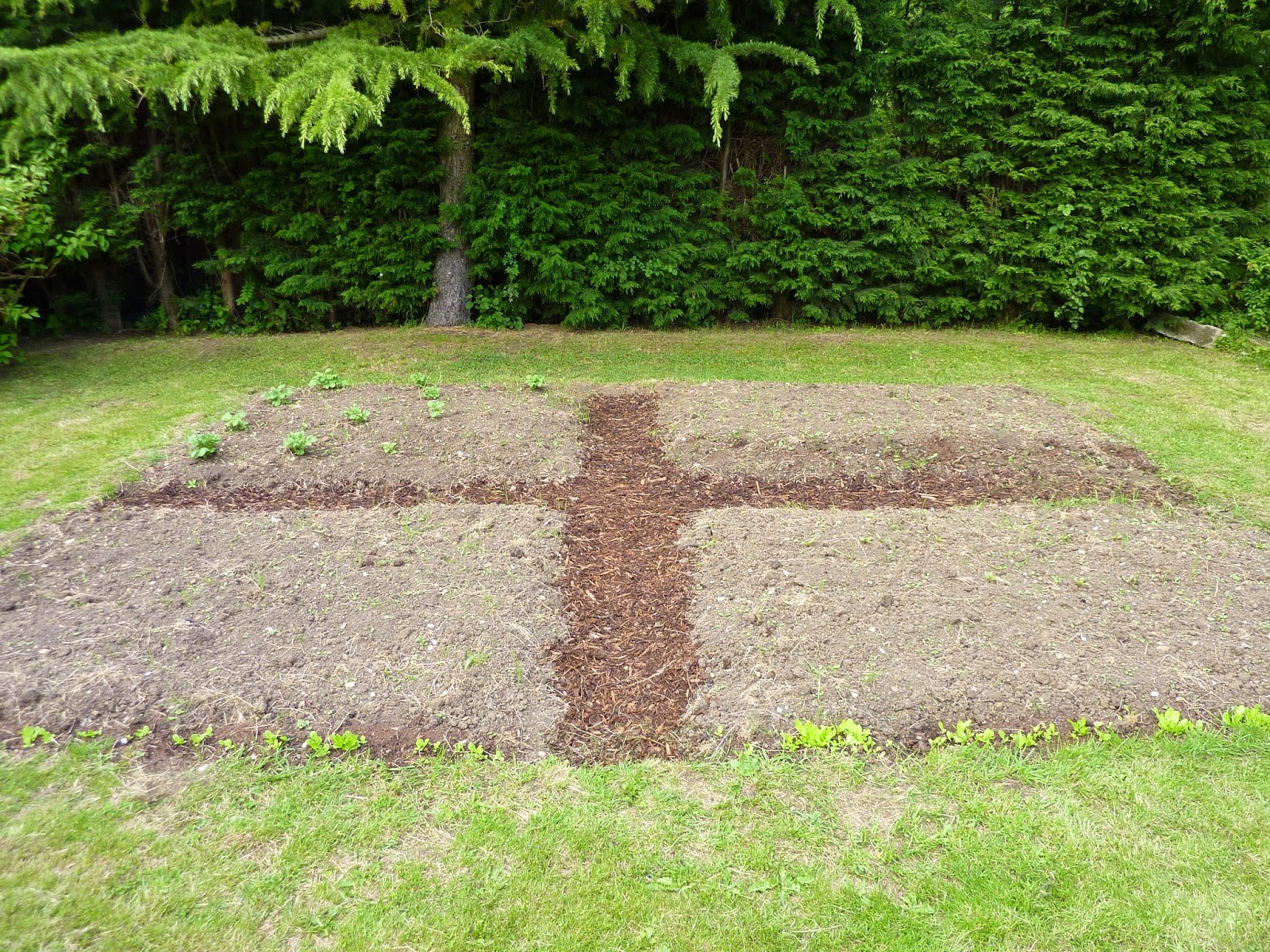
The vegetable plot is a traditional 4- plot rotation separated by a crossed path of bark chippings. The rotation is to go clockwise each year to avoid soil borne pests and diseases, and to permit the soil to recover from the unique absorptive demands of the crop being grown. The vegetable plot has a central cross of bark chippings to separate the individual rotations. It is dug deeply to ensure adequate separation. The use of bark chippings is of value because in wet weather it serves to drain water away, yet acts as a reservoir in dry weather, thus acting as a natural buffer against waterlogging or drought. It is a weed- free and convenient way to attend to crops, and prevents compaction of soil. The material is an inexpensive natural product which will biodegrade slowly without leaving any toxic or unpleasant residue.

Salad vegetables growing at the periphery of the plots. These plants can be grown intermingled with the other (root) crops and do not negatively influence the rotation.

Above: the first step towards verticality and ployculture. I have added red and black current bushes at the periphery of the plot. In subsequent years other plants are to follow: rhubarb, herb bushes such as rosemary, lavender, sage, and other backyard permaculture orchard standards such as apple, pear, apricot, plums, etc. In this way, the food growing area will migrate from a traditional 4- plot system with straight lines, to a more various and stratified polyculture.
Thursday, 28 August 2014
Greenhouse

This is a photograph of the greenhouse after clearing it of the intrusive vine, installing the wire shelving, and attaching the shallow shelves for salad vegetables to the potting table (not visible). On the L side of the greenhouse in the picture, against the sun- facing glass I affixed 3 A-frames made of bamboo and secured with twine. The A- frames were used as a surface against which I grew several varieties of tomatoes.

Above: Shallow shelves in operation, planted up with salad seeds. Cultivating salad leaves in this way is successful in preventing insect damage because (i) fresh compost is used each season, (ii) the soil is not contiguous with any other source of soil bourne contamination, (iii) the bed is raised and difficult for insects to encroach, (iv) being inside the greenhouse, adequate sunlight, moisture and insulation permit good growth.

Making use of the margins: The strawberries pictured here receive some runoff from the greenhouse roof, and so are less labour intensive in their water requirement.

Using the plasticised wire shelving permitted free circulation of air, water percolation and drainage, and vertical storage for a variety of plants in their germination stage (and for some low growing plants and herbs for the duration of the season). The shelves were found in the garage in a dismantled & twisted state and required some ingenuity in putting back together to the required size/ shape.

Green Pepper seedlings.
Two Interviews with David Holmgren
Thursday, 14 August 2014


Wendell Berry on Food
“The passive American consumer, sitting down to a meal of pre-prepared food, confronts inert, anonymous substances that have been processed, dyed, breaded, sauced, gravied, ground, pulped, strained, blended, prettified, and sanitized beyond resemblance to any part of any creature that ever lived. The products of nature and agriculture have been made, to all appearances, the products of industry. Both eater and eaten are thus in exile from biological reality.”
“Eating with the fullest pleasure – pleasure, that is, that does not depend on ignorance – is perhaps the profoundest enactment of our connection with the world. In this pleasure we experience our dependence and our gratitude, for we are living in a mystery, from creatures we did not make and powers we cannot comprehend.”
“A person who undertakes to grow a garden at home, by practices that will preserve rather than exploit the economy of the soil, has his mind precisely against what is wrong with us… What I am saying is that if we apply our minds directly and competently to the needs of the earth, then we will have begun to make fundamental and necessary changes in our minds. We will begin to understand and to mistrust and to change our wasteful economy, which markets not just the produce of earth, but also the earth’s ability to produce.”
“But even in the much-publicized rebellion of the young against the materialism of the affluent society, the consumer mentality is too often still intact: the standards of behavior are still those of kind and quantity, the security sought is still the security of numbers, and the chief motive is still the consumer’s anxiety that he is missing out on what is “in.” In this state of total consumerism – which is to say a state of helpless dependence on things and services and ideas and motives that we have forgotten how to provide ourselves – all meaningful contact between ourselves and the earth is broken. We do not understand the earth in terms either of what it offers us or of what it requires of us, and I think it is the rule that people inevitably destroy what they do not understand.

“Eating with the fullest pleasure – pleasure, that is, that does not depend on ignorance – is perhaps the profoundest enactment of our connection with the world. In this pleasure we experience our dependence and our gratitude, for we are living in a mystery, from creatures we did not make and powers we cannot comprehend.”
“A person who undertakes to grow a garden at home, by practices that will preserve rather than exploit the economy of the soil, has his mind precisely against what is wrong with us… What I am saying is that if we apply our minds directly and competently to the needs of the earth, then we will have begun to make fundamental and necessary changes in our minds. We will begin to understand and to mistrust and to change our wasteful economy, which markets not just the produce of earth, but also the earth’s ability to produce.”
“But even in the much-publicized rebellion of the young against the materialism of the affluent society, the consumer mentality is too often still intact: the standards of behavior are still those of kind and quantity, the security sought is still the security of numbers, and the chief motive is still the consumer’s anxiety that he is missing out on what is “in.” In this state of total consumerism – which is to say a state of helpless dependence on things and services and ideas and motives that we have forgotten how to provide ourselves – all meaningful contact between ourselves and the earth is broken. We do not understand the earth in terms either of what it offers us or of what it requires of us, and I think it is the rule that people inevitably destroy what they do not understand.
from The Art of the Commonplace: The Agrarian Essays of Wendell Berry
Medicine Wheel Herb Garden


Good Book on designing a Medicine Wheel, and the theory behind it:
The Medicine Wheel Garden: Creating Sacred Space for Healing, Celebration, and Tranquillity by E. Barrie Kavasch

Wednesday, 13 August 2014


Killing Fields & The Meatrix
Killing Fields: The True Cost of Europe’s Cheap Meat (2009)
Cheap meat has become a way of life in much of Europe, but the full price is being paid across Latin America as vast soya plantations and their attendant chemicals lead to poisonings and violence. An investigation in Paraguay has discovered that vast plantations of soy, principally grown for use in intensively-farmed animal feed, are responsible for a catalogue of social and ecological problems, including the forced eviction of rural communities, landlessness, poverty, excessive use of pesticides, deforestation and rising food insecurity. For a full report by Andrew Wasley in The Ecologist, click here.
Subscribe to:
Posts (Atom)